Sustainable Travel in Oita
-1.jpg?width=700&height=466&name=%E3%82%AF%E3%83%8C%E3%82%AE%E3%81%A8%E3%81%9F%E3%82%81%E6%B1%A0(%E9%AB%98%E7%94%BB%E8%B3%AA)-1.jpg)
In May 2013, Oita Prefecture’s Kunisaki Peninsula Usa area (which includes Bungotakada City, Kitsuki City, Usa City, Kunisaki City, Himeshima Village, and Hiji Town) was designated as a Globally Important Agricultural Heritage System (GIAHS). In the Usa region of the Kunisaki Peninsula, where rainfall is low and water is not easily secured, small-scale ponds have been connected to obtain stable water for agriculture, leading to efficient land and water use. The area is surrounded by Sawtooth Oak forests that replenish the water of the irrigation ponds, making the landscape unique. The water supplied by the irrigation ponds supports paddy field agriculture, such as paddy rice and Shichitoi. In this area, log wood cultivated Shiitake production using Sawtooth Oak forests is traditionally carried out. Since Sawtooth Oak trees regenerate from stumps after about 15 years, log wood cultivation of Shiitake fosters the renewal of the forests, preserving the prime environment and landscape of the satoyama (rural area).
What are Globally Important Agricultural Heritage Systems?
In 2002, the Food and Agriculture Organization of the United Nations (FAO), an international organization that aims to secure stable food supplies, launched a project to recognize globally important agricultural systems that combine traditional farming and agricultural methods that should be handed down to future generations with the culture, landscape, and biodiversity nurtured through these systems, and works toward their conservation and sustainable use.
There are 67 certified Globally Important Agricultural Heritage Systems worldwide (as of July 2022), 13 of which are in Japan, including Oita Prefecture's " Sawtooth Oak Forests and Irrigation Ponds Connecting the Kunisaki Peninsula Usa Integrated Forestry Agriculture and Fisheries System."

Shiitake Mushrooms Grown in Oita
%E3%81%97%E3%81%84%E3%81%9F%E3%81%91-1.jpg?width=700&height=466&name=%E6%B8%88)%E3%81%97%E3%81%84%E3%81%9F%E3%81%91-1.jpg)
Oita Prefecture boasts the highest production and quality of dried shiitake mushrooms in Japan and has won the group championship in the National Dried Shiitake Mushroom Fair 55 out of 69 times for 23 consecutive years (FY2022). Shiitake mushrooms are most commonly grown in two ways: log cultivation and mushroom bed cultivation. Oita Prefecture boasts the largest amount of Sawtooth Oak trees, required to produce shiitake mushrooms, accounting for about 28% of Sawtooth Oak trees nationwide. Thanks to the abundant Sawtooth Oak forests, most dried shiitake mushrooms produced in Oita Prefecture are grown on logs.
What is log wood cultivation?
Log wood, such as from Sawtooth Oak forests, is cut into 1 to 1.2-meter lengths, planted with shiitake mushroom fungi, and cultivated in the wild without pesticides. After about two years of cultivation, the planted fungi spread throughout the logs, producing shiitake mushrooms harvested in spring and fall. As these shiitake mushrooms are naturally cultivated, and production relies on the climate and other conditions, harvesting is less stable than shiitake bed cultivation. Most are sold as dried shiitake mushrooms.
What is Shiitake bed cultivation?
Shiitake mushrooms are cultivated in 20 cm square blocks (mushroom beds) mixed with sawdust and other nutrients, and grown in a dark room with high humidity, where the temperature and humidity are controlled. This stable environment allows shiitake mushrooms to be harvested throughout the year in a 3-6 month cycle, so most fresh shiitake mushrooms found in supermarkets are grown on mushroom beds.
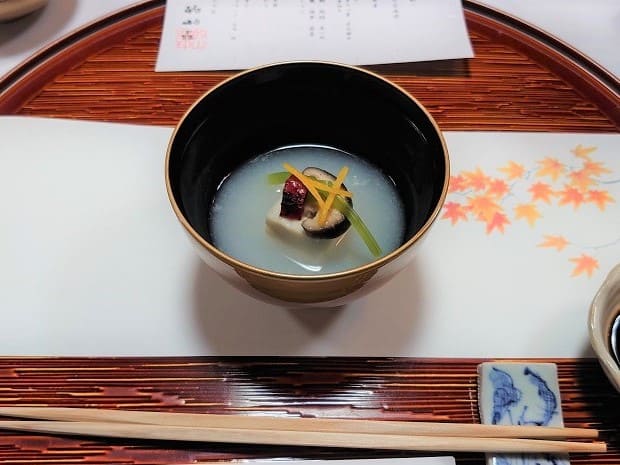
Dishes made with shiitake mushrooms on this trip.

.jpg?width=959&height=719&name=%E7%8E%89%E3%81%AE%E6%B9%AF2_%20(1).jpg)
%E4%BA%80%E3%81%AE%E4%BA%95%E5%A4%95%E9%A3%9F%20%E7%B7%A8%E9%9B%86%E6%B8%88-1.jpg)

%E7%94%B1%E5%B8%83%E5%B2%B3-1.jpg?width=700&height=464&name=%E6%B8%88)%E7%94%B1%E5%B8%83%E5%B2%B3-1.jpg)
Yufuin is a town in the center of Oita Prefecture, surrounded by mountains and rice paddies.The history of Yufuin's town development dates back to 1924, when Dr. Seiroku Honda, a forestry scholar, and landscape architect, said in a lecture, "We should aim to recreate a hot spring resort in Germany." In 1971, three local ryokan managers visited a resort in Germany and proposed a town development plan called the "Kurort Concept." They called for the importance of nature conservation and aimed to create a German-style spa resort where residents could enjoy a comfortable living environment and tourists could also enjoy their stay. Yufuin is what it is today thanks to their efforts to involve the tourist association, the ryokan association, the town council, and the local government.Today, Yufuin continues to hold film and music festivals that tourists and residents alike can enjoy creating a sustainable community. Yufuin is also one of the most popular spots in Oita Prefecture, and the area around JR Yufuin Station attracts many tourists. This tour introduced the tranquil side of Yufuin and its tourism town development plan for the next 100 years.
The numerous Rokugomanzan temples scattered throughout the Kunisaki Peninsula are said to have been founded by Ninmon Bosatsu in the second year of the Yoro period (718). As an incarnation of the deity Usa Hachiman, Ninmon Bosatsu founded the mountain religion of Rokugomanzan, the origin of the syncretism of Shintoism and Buddhism, in Usa, Kunisaki approximately 1,300 years ago.
%E6%96%87%E6%AE%8A%E4%BB%99%E5%AF%BA-1.jpg?width=700&height=465&name=%E6%B8%88)%E6%96%87%E6%AE%8A%E4%BB%99%E5%AF%BA-1.jpg)
About the Rokugomanzan Culture
Rokugomanzan was a group of temples that developed in the valleys of six hamlets (Kunawa, Tashibu, Imi, Kunisaki, Musashi, and Aki) on the Kunisaki Peninsula, and were divided into three branches (Motoyama to study, Nakayama for practice, and Sueyama as a missionary) based on the purpose of their activities. The Kunisaki Peninsula was one of the first areas in Kyushu where Buddhism flourished as a place of practice of the Tendai sect transmitted to Usa Jingu and Mirokuji Temple, and while strongly influenced by the Usa Hachiman deities, it blossomed a unique Rokugomanzan culture through a fusion with mountain religion that favored training in the harsh terrain. For this reason, the culture of Shinto and Buddhism is strong in Rokugomanzan, with shrines and temples existing in unison, and some shrines being equal in size to temples. In addition, depending on the temple, there is a place for ascetic practices (Iwaya, Mumyo Bridge, etc.) in the yaba (rocky peaks) in the hinterland.
Map of Usa Jingu & Rokugo Manzan Sacred Sites
Photo Gallery
Oita Prefecture Map
Oita Prefecture Official YouTube Channel - Explore Oita Japan
Oita Prefectural Tourism Association "Tourism Oita"